

Category

Racing

Race Planning And Reflection

An important part of racing is making plans for the race and reflecting on how the race went.

By working thru the process this helps you feel confident and relaxed going into the race knowing what you need to do and when.

Just as importantly is reflecting on how you went against your plan so you can celebrate race dace successes and identify lessons to be learned and what to work on for your next race.

The Process

Racing

  1. Record your tactical, technical, mental, physical and nutrition plan for the race the day before in the “Race day plan and goals/targets” activity in TP. As part of this process review your last race notes and include anything you identified to work on in your plan. Record these in the workout comments. Ideally do this a day or two before the race so on the day before the race you can relax knowing you have a plan for the following day. If required adjust the plan after arriving at the race and team meetings.
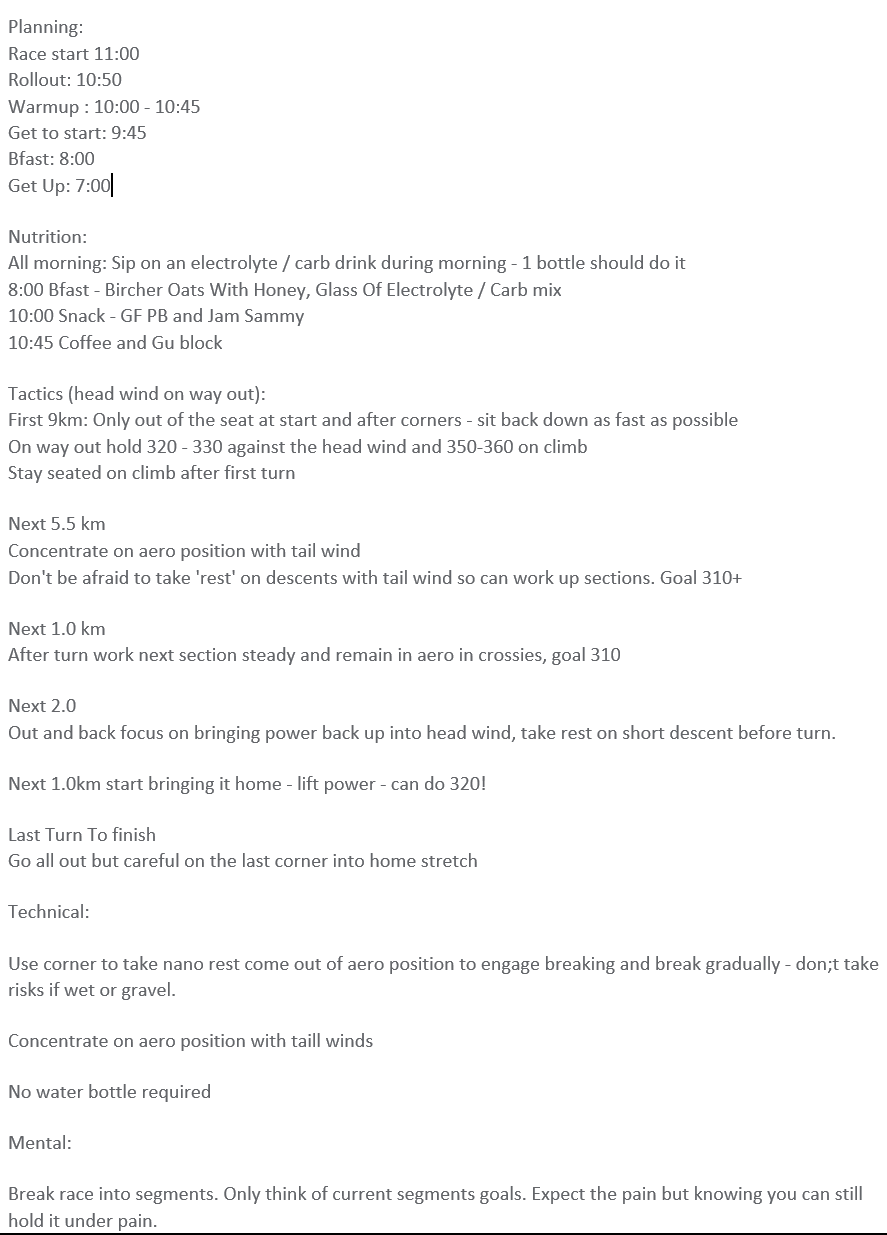
  2. Record metrics on the morning of the race.
  3. Upload your race as soon as possible on completion and record the following:
    1. How you felt and how hard the race was.
    2. Review the race and make comments to record if you achieved your goals and what were your race limiters.  Always focus on at least 3 positive aspects and chose the key things you need to improve on in your training and or your next race.
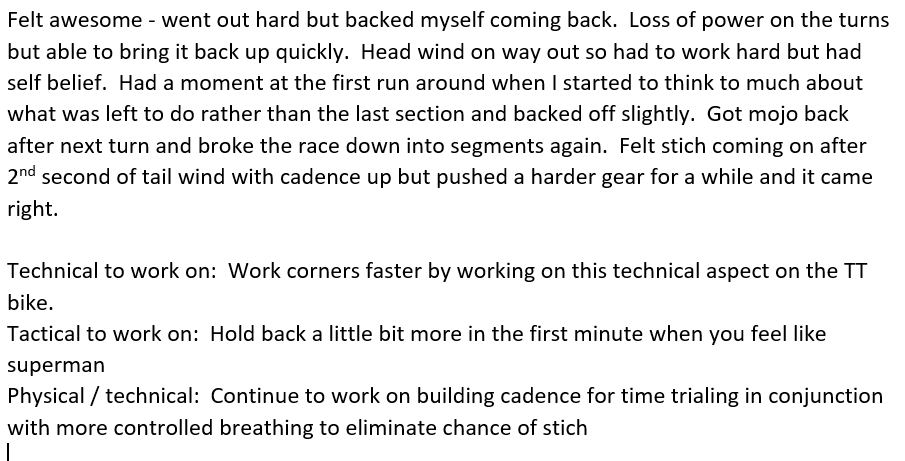
The Why

Our goals is to develop you into the best you can be.  To do that you have to be continually challenging yourself and identify improvements to make. It is a team effort and visibility for everyone involved is critical.  The reason why we are asking you to do the above are detailed below.  Hopefully by understanding the why it will motivate you to complete these tasks in a timely fashion and get as much out of the process as possible.

Racing

  1. Helps you plan for your race setting tactical, technical, physical, mental and nutritional goals.
  2. Helps you reflect on your race in a timely fashion so you can celebrate what went right and identify what you need to work on in your training and or next race.  By doing this ASAP you can put the race to ‘bed’ and focus on the positive actions or your next race – although if it was the perfect race you can hang on and talk about the success for a bit longer if you want!
  3. Informs us as coaches how your race went so that we can adapt training to strengthen any weaknesses and work with you on any technical / tactical / mental / nutritional strategies for the following races.  This is especially important when you are racing remotely and sometimes communications across time zones is difficult.
  4. As with the training above this is also very helpful for third parties (e.g current team, future team etc). By showing you are a thinking and informed athlete there is more likely that you will be respected by your current team and seen as a good potential for future teams.
Heart Rate Variability – An Introduction

HRV Explained


Heart rate variability or HRV is the physiological phenomenon of the variation in the time interval between consecutive heartbeats in milliseconds. A normal, healthy heart does not tick evenly like a metronome, but instead, when looking at the milliseconds between heartbeats, there is constant variation.

HRV is regulated by the autonomic nervous system (ANS), and its sympathetic and parasympathetic branches.
The Sympathetic Nervous System controls your body’s “fight or flight” reactions in response to internal or external stressors. It stimulates blood glucose (to fuel your muscles), pupil dilation (to see tigers better), slows digestion/peristalsis (to focus energy on the present danger), and increases heart rate (to ensure adequate blood circulation to run or fight). The SNS is ideally activated to overcome short term stress situations such as running from a tiger or fighting an intruder.

The Parasympathetic Nervous System controls your body’s “rest and digest” responses and is associated with recovery. Parasympathetic activation conserves energy, constricts pupils, aids digestion, and slows heart rate. The PSNS is meant to help build for the long term and is needed to grow faster, stronger, and healthier.

Heart Rate Variability is an accurate, non-invasive measure of the ANS and the balance between the SNS and PSNS branches.

The HRV level changes naturally from day to day, based on the level of activity and amount of stress.

The natural interplay between the two systems can be disrupted, and the body can get stuck in a sympathetically dominant fight state, with low HRV and high stress hormone levels, even when the person is resting.
This is very consuming on the body and can result in various mental and physical health problems.

What Do HRV Readings Mean?

Higher resting-state HRV scores signify the ability of the body to activate the Parasympathetic “rest-and-digest” response. Higher heart rate variability is correlated with:


• Increased fitness level
• Better health
• Better resilience
• Youthfulness
• Willpower
• Calm, positive emotions

Lower resting-state HRV scores signify an activated Sympathetic “fight-or-flight” response or suppressed Parasympathetic activity. This can indicate the body’s inability to engage recovery mode or an exhaustion of recovery capacity. This can be a temporary response to a previous day’s hard workout or poor night of sleep. Or this can be a chronic response to stress that results in reduced health and increased risk of disease. Lower resting-state HRV is tied to:


• Reduced fitness level
• Poor health
• Increased disease risk and inflammation
• Increased biological age
• Negative emotions
• Increased anxiety and depression

HRV At ESP

We use Elite HRV for recording and monitoring HRV.

The app lets you tag your HRV measurements with the important things going on in your life and then helps you analysis the results and provides daily HRV-based guidance.

Our athletes synchronise their HRV reading into TP so we can get a full picture of their response to training stress.

As a coach / athlete we need to monitor HRV and the bodies corresponding nervous system response to insure we balance the correct amount of training stress and recovery for the body to adapt as planned. HRV is fantastic as it takes into account other stressors on the body as well as training stress.

Not only do we use HRV for adapting the training and recovery for our athletes but it is also a vital tool for helping athletes recover from sickness or injury by fine tuning the timing and intensity of returning to training.
As we collect more data and source more training on HRV we will be able to fine tune and individualise your training even more than we currently do.

For an interesting podcast on how HRV is being used with Elite athletes check out this:

Olympic Training And Elite Endurance

Recording Devices

To measure HRV an accurate and convenient heart rate monitor will be necessary. HRV data is quite sensitive, so not all heart rate monitors will work.

Our preferred options to work with Elite HRV are the CorSense finger sensor or accurate Bluetooth Heart Rate Straps such as the Garmin or Wahoo Tickr.

Currently wrist based devices such as wearable watches are not accurate enough to be used with Elite HRV.

Information from Heart Rate Variability: A Deeper Metric by Elite HRV

1 2 3 4